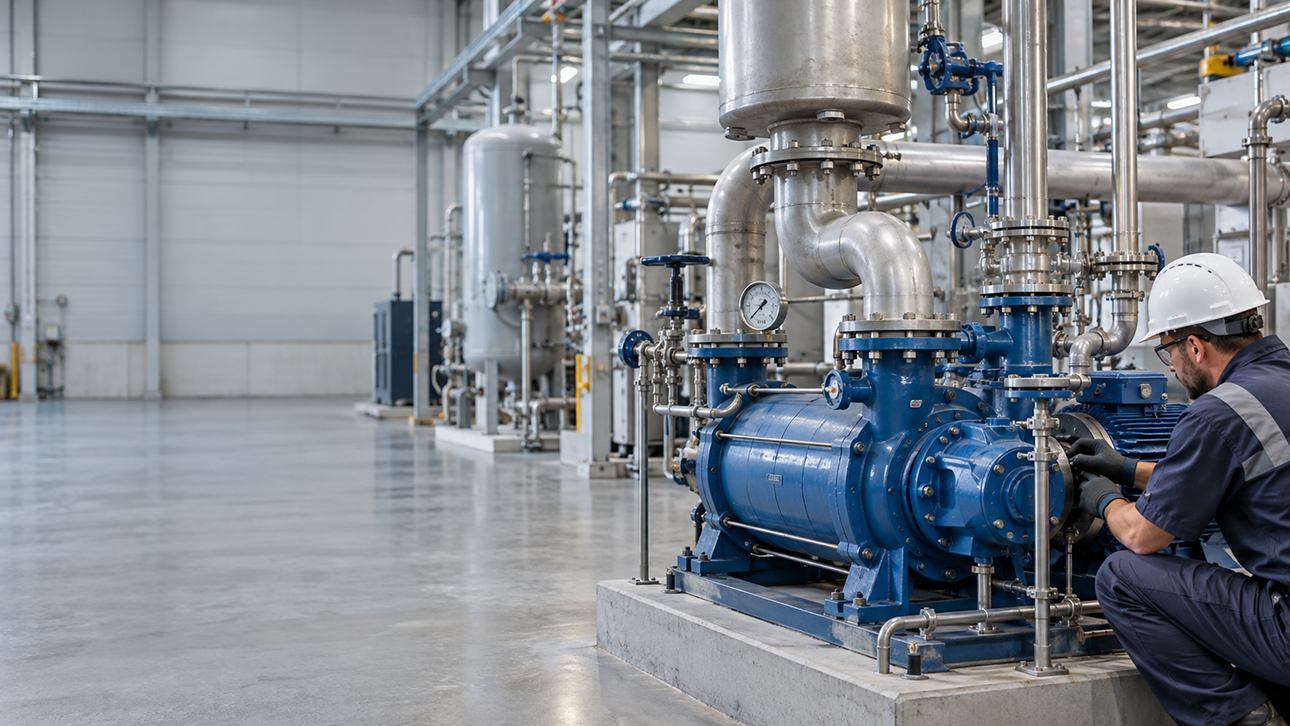
Why does a vacuum pump lose efficiency? The most common causes and how to address them
Loss of Vacuum Pump Efficiency: A Problem That Should Not Be Underestimated
A vacuum pump is designed to deliver reliable and consistent performance, even in particularly demanding industrial applications. Over time, however, a gradual loss of efficiency may occur: the required vacuum level is reached more slowly, suction capacity decreases, or energy consumption, operating temperatures and maintenance requirements increase.
There can be several causes, and they are not necessarily related exclusively to the pump itself. Mechanical wear, deteriorated seals, dirty valves and air leaks in the system can affect the operation of the entire installation.
Quickly identifying the source of the problem makes it possible to intervene before reduced performance develops into a malfunction or production downtime. For this reason, regular inspections and maintenance play a fundamental role in the management of industrial vacuum pumps.
Mechanical Wear and Component Deterioration
Mechanical wear is one of the most common causes of a gradual decline in performance. Components subjected to continuous movement, friction and mechanical stress may undergo changes in their dimensional and functional characteristics over time.
The type of wear naturally depends on the pump technology. In oil-lubricated rotary vane pumps, for example, vane deterioration can increase internal clearances and reduce the ability to achieve the required vacuum level. In other technologies, such as liquid ring vacuum pumps, the condition of the rotor, seals, bearings and internal surfaces must be considered, along with the proper management of the service liquid.
A gradual increase in vibration, noise or temperature may indicate a problem that requires further investigation. Prompt intervention helps prevent wear affecting a single element from causing damage to other components of the machine.
Deteriorated Seals and Air Leaks in the System
To achieve and maintain a vacuum, the entire circuit must provide an adequate level of tightness. A deteriorated seal, a damaged O-ring, an improperly tightened flange or a cracked pipe can cause an air leak.
Even a seemingly minor leak can have significant consequences: the pump must continuously evacuate the air entering the circuit and may therefore take longer to reach the required pressure.
When a loss of efficiency occurs, it is important to inspect not only the machine itself but the entire vacuum system. Pipes, fittings, flanges and connection points must be carefully checked to identify any leaks.
A correct diagnosis also prevents unnecessary work on the pump when the actual cause of insufficient performance lies upstream or downstream of the machine.
Valves, Filters and Deposits: When Flow Is Restricted
Valves play an important role in regulating flow within the system. Deposits, particles or process residues can compromise their operation and limit the system’s ability to properly handle gases and vapours.
The same applies to filters. An excessively dirty filter element creates a pressure drop that can reduce the available flow rate and alter the pump’s operating conditions.
In applications involving particles, condensable vapours or process fluids, it is therefore essential to schedule regular inspections and cleaning. Keeping flow passages clear and checking that valves operate correctly helps preserve the efficiency of the vacuum pump and the system as a whole.
Lubrication and Service Liquid: Consider the Pump Technology
In pumps that use oil, contaminated or degraded lubricant may lose some of its lubricating and sealing properties. Moisture, particles and process contaminants can also accelerate component wear and compromise performance.
For this type of machine, it is therefore essential to follow the recommended replacement intervals and use the lubricant specified by the manufacturer.
The operating principle is different in liquid ring vacuum pumps, a technology in which Azmec specialises. In this case, particular attention must be paid to the service liquid, its temperature, flow rate and the possible presence of contaminants or deposits. Suboptimal conditions can directly affect the pump’s capacity and the vacuum level that can be achieved.
Maintenance must therefore always be defined according to the specific technology and actual operating conditions.
How to Restore Vacuum Pump Efficiency
When performance begins to decline, relying on trial and error can lead to unnecessary costs. It is preferable to carry out a structured diagnosis, progressively checking the operating conditions of the machine and the entire system.
The most important measures include:
– checking pipes, fittings and flanges to identify any air leaks;
– checking the condition of each seal and other sealing elements;
– cleaning filters and valves, removing deposits and contaminants;
– checking the condition of components subject to mechanical wear;
– checking the lubricant or service liquid, depending on the technology used;
– comparing the flow rate, pressure and operating temperature with the specified design values.
Scheduled maintenance also makes it possible to identify many of these issues before they cause a significant loss of performance.
Azmec: Technical Expertise to Maintain High Performance Over Time
A vacuum pump that is losing efficiency should not necessarily be considered a machine that has reached the end of its operational life. In many cases, an accurate diagnosis makes it possible to identify the cause and restore proper operating conditions through maintenance, cleaning, overhaul or replacement of worn components.
Azmec supports companies not only in the design and supply of liquid ring vacuum pumps and compressors, but also by providing the technical support needed to preserve their reliability and performance over time.
Is your vacuum pump no longer achieving the expected performance? Contact the Azmec team to assess the condition of your system and identify the most appropriate solution. Professional maintenance and a thorough analysis of the system can make the difference between a gradual decline in efficiency and a machine capable of continuing to operate reliably over time.